

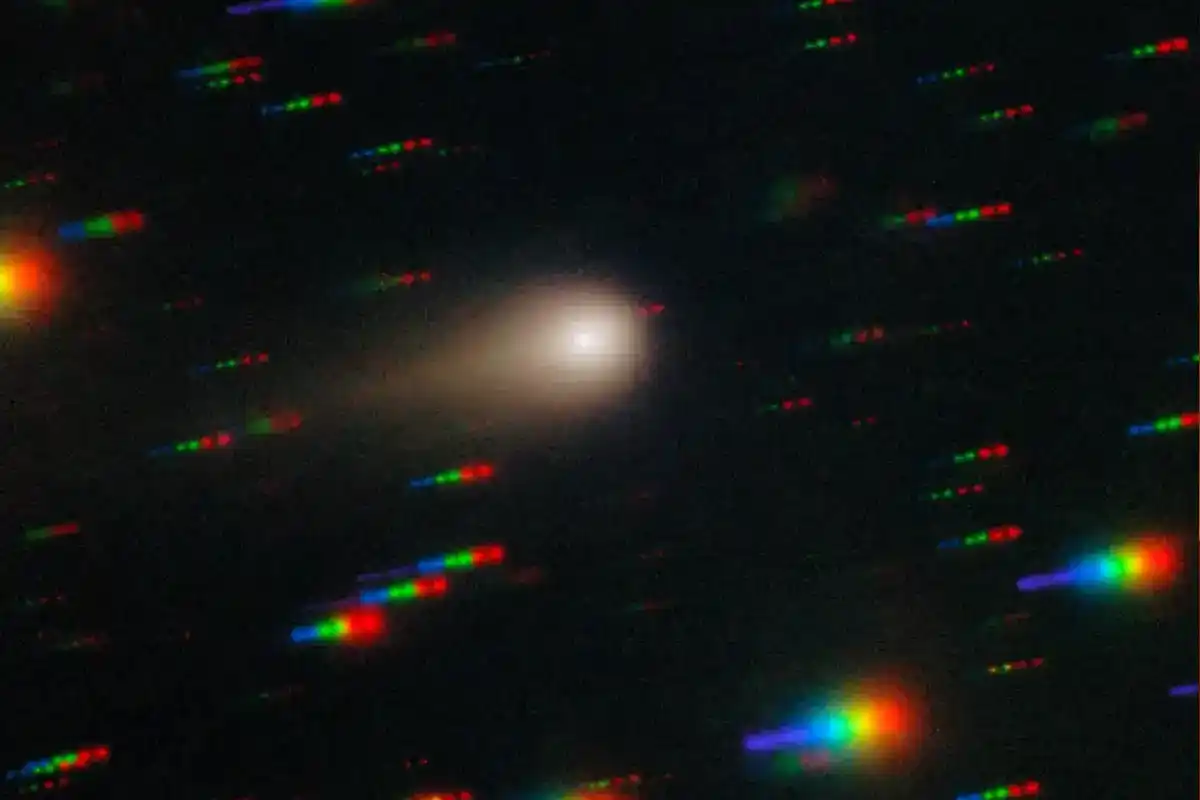
A comet from another star system is acting strangely. It is named 3I/ATLAS. Scientists have noticed it pulses like a heartbeat. Its light gets brighter and dimmer in a steady rhythm. This pattern repeats every 16.16 hours.
This has caused a lot of talk online. Some people wondered if this pulse could affect Jupiter’s moon, Callisto. They asked if it could send energy that way. Scientists say this is completely false.
The comet’s pulse is not dangerous. It does not change the comet’s path. It does not send force or radiation to any planets. It will not come close to Jupiter or its moons. The effect is only about light.
Why is the comet pulsing?
Scientists first had one idea. They thought the comet’s core, or nucleus, was spinning. Many comets spin. As different sides face the Sun, the brightness can change. But new data from the Hubble Space Telescope changed things.
Hubble showed the main light is not from the comet’s solid core. The core is actually very small and faint. The light comes from a huge cloud around the comet. This cloud is called a coma. It is made of gas and dust.
Because the core is so small, its spin cannot explain the big brightness changes. So scientists now have a new theory. They call it “jet activity.”
Here is how jet activity might work. There could be a special spot on the comet’s surface. This spot has more frozen gas. When this spot rotates to face the Sun, the ice heats up. The heated gas then shoots out into space very fast, like a jet.
This jet makes the surrounding coma expand quickly. A bigger, puffier coma reflects more sunlight. So, the whole comet looks much brighter from Earth.
When that active spot rotates away from the Sun, the jetting stops. The coma settles down. The comet appears dim again. This cycle fits the 16.16-hour pulse perfectly.
What happens next?
Researchers want to watch the comet for long periods. They need to see if the brightening always happens at the same rotation phase. If it does, it will strongly support the jet theory.
This comet is very special. It is only the third object ever found visiting our solar system from another star. Every new detail teaches scientists more about how other star systems work.
For now, the mysterious heartbeat of 3I/ATLAS remains a fascinating puzzle. It is a harmless cosmic curiosity, shining its rhythmic light from the depths of interstellar space.
