

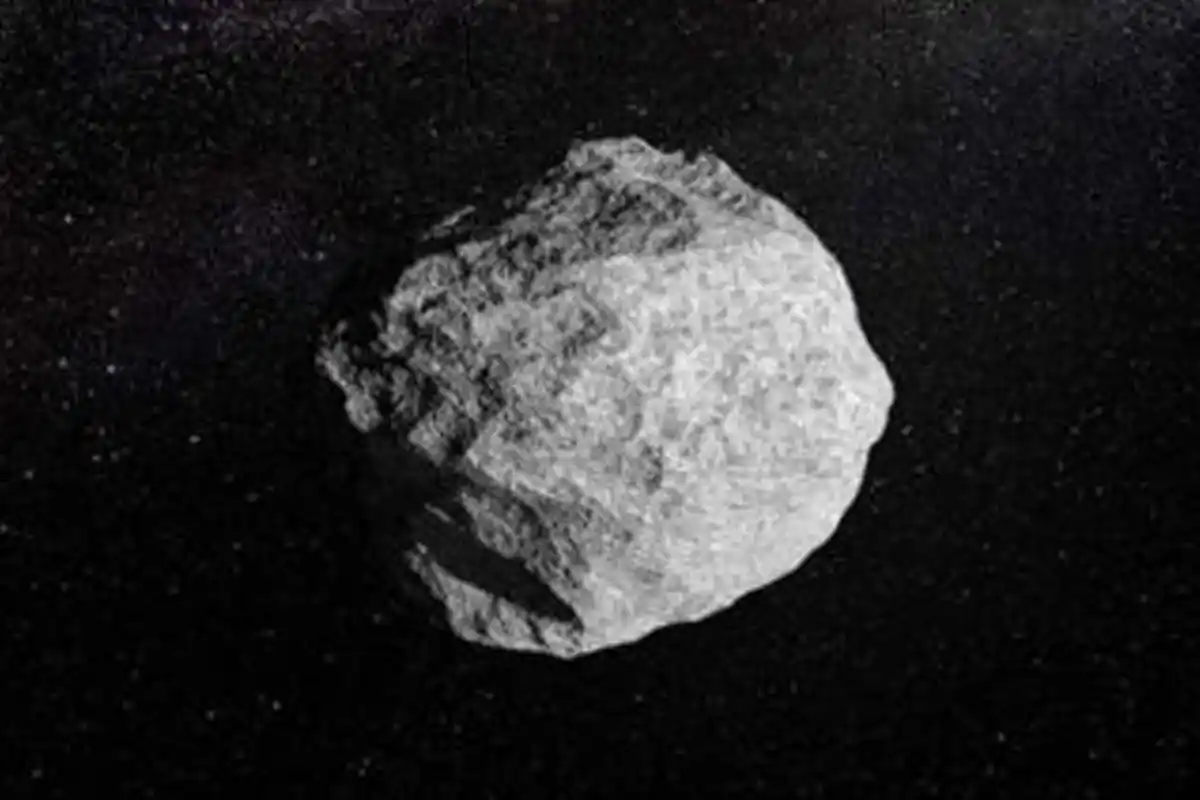
Astronomers are closely tracking a newly identified asteroid named 2024 YR4, after calculations showed it has a small but notable chance of striking the Moon in May 2032. Scientists say that if the impact occurs, it could create a bright flash visible from Earth.
The asteroid is estimated to be around 200 feet (60 metres) wide. Current projections suggest about a 4 percent chance, or 1 in 25 probability, of a lunar impact. Experts stress that these odds may change as more observational data becomes available over the coming years.
What Is Asteroid 2024 YR4?
Asteroid 2024 YR4 was first detected in late 2024. Since then, international space agencies have been refining its orbit to determine how it will pass through the Earth–Moon system in 2032.
While near-Earth objects of this size often raise concerns about Earth impacts, scientists say the current risk to Earth is extremely low. Instead, the Moon appears to be the more likely target based on present trajectory models.
What Would Happen If It Hits the Moon?
At around 200 feet wide, 2024 YR4 is similar in size to the asteroid linked to the 1908 Tunguska event. Unlike Earth, the Moon has no atmosphere, meaning the asteroid would strike the surface at full speed.
Scientists estimate the impact would:
-
Create a new lunar crater
-
Release a strong thermal burst
-
Produce a brief flash of light
If the impact happens on the side of the Moon facing Earth, observers may see a momentary, star-like flash, possibly with small telescopes or even the naked eye under ideal conditions.
Why the Moon Is at Risk, Not Earth
Experts explain that the asteroid’s orbit places it in a narrow path where the Moon’s gravity could pull it in during its May 2032 flyby.
Although Earth is much larger, recent tracking data has largely ruled out an Earth impact. However, scientists continue monitoring because small forces — such as solar radiation pressure or gravitational interactions — can slightly alter an asteroid’s path over time.
How Scientists Are Monitoring the Asteroid
The asteroid is being tracked by NASA’s Center for Near-Earth Object Studies (CNEOS) and other global observatories.
Because 2032 is still years away, the asteroid will move in and out of visibility. Each new observation helps scientists refine its orbit and reduce uncertainty. In most cases like this, additional data eventually confirms that the object will miss entirely.
Why a Lunar Impact Would Matter
If 2024 YR4 does strike the Moon, it would offer scientists a rare chance to observe a lunar impact in real time.
Orbiting missions such as NASA’s Lunar Reconnaissance Orbiter (LRO) could capture detailed images of the impact site before and after the event. This information would help researchers understand how the Moon’s surface reacts to high-speed collisions.
Such data is especially valuable as space agencies plan future human missions and habitats on the Moon under programs like NASA’s Artemis initiative.
What Happens Next?
For now, astronomers will continue tracking asteroid 2024 YR4 and updating predictions as new data becomes available. While the chance of impact is still low, scientists say it remains an event worth watching.
