







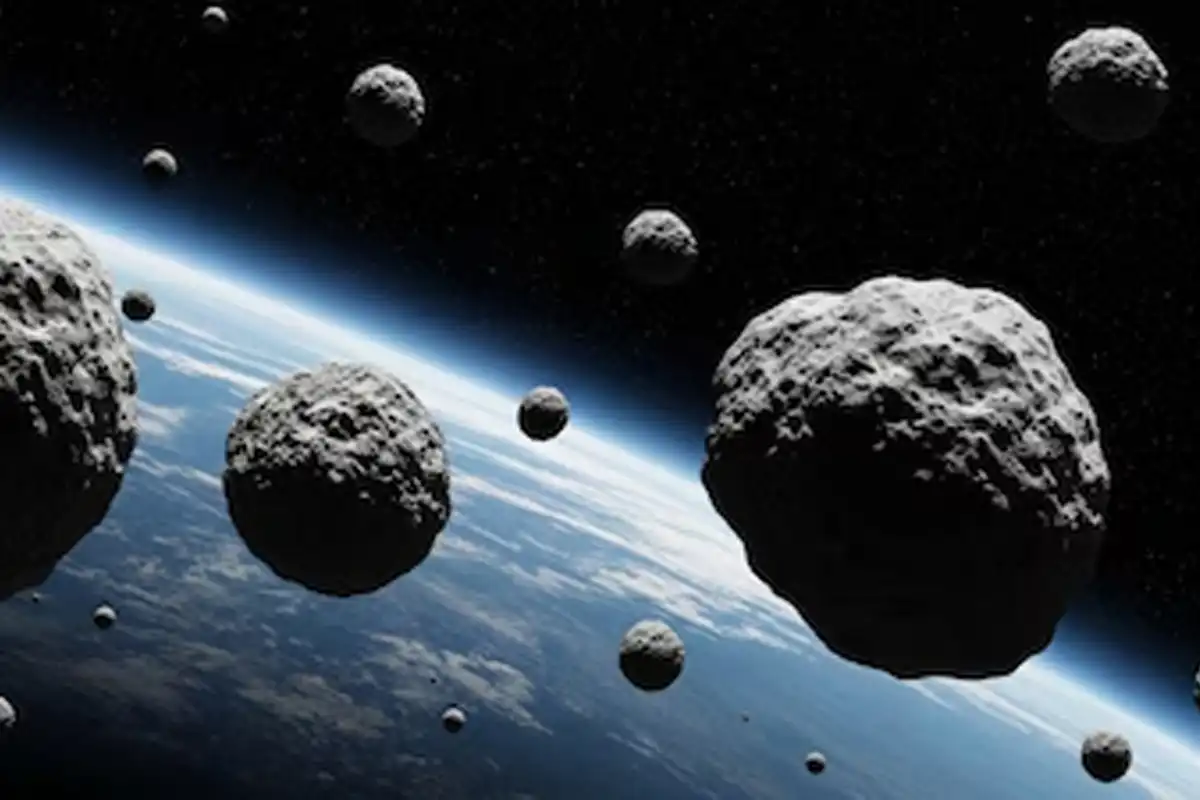
Scientists have warned that thousands of potentially destructive “city-killer” asteroids remain undetected, raising concerns about planetary defence preparedness.
Speaking at the American Association for the Advancement of Science conference in Phoenix, Dr Kelly Fast, NASA’s planetary defence lead, revealed that around 15,000 mid-sized near-Earth objects (NEOs) — each at least 140 metres wide — have yet to be identified. An asteroid of that size striking a populated region could cause devastating regional damage.
NASA Sounds Alarm On ‘City-Killers’
According to reports, Dr Fast emphasised that the real concern lies not with the massive, extinction-level asteroids often depicted in films, but with mid-sized objects capable of causing severe regional destruction.
“It’s really the asteroids that we don’t know about,” she said. “We’re not so much worried about the large ones from the movies, because we know where they are. And small stuff is hitting us all the time. It’s the ones in-between that could do regional damage.”
She added that even the world’s most powerful telescopes cannot detect every object in space, leaving significant blind spots.
Dr Nancy Chabot of Johns Hopkins University, who led NASA’s Double Asteroid Redirection Test (DART) mission, echoed those concerns. While DART successfully demonstrated asteroid deflection by crashing a spacecraft into Dimorphos at 14,000 mph to alter its orbit, she noted that no ready-to-launch planetary defence spacecraft currently exists.
“DART was a great demonstration. But we don’t have another sitting around ready to go if there was a threat that we needed to use it for,” Chabot said.
She further warned that if a newly detected asteroid such as YR4 had been on a confirmed collision course with Earth, there would be no immediate active deflection option available.
Only 40% Of Objects Larger Than 140 Metres Tracked
Concerns heightened after asteroid YR4, roughly the size of a football pitch, was detected following a close pass by Earth on Christmas Day 2024. Although subsequent calculations ruled out a potential 2032 impact, the episode exposed gaps in global detection systems.
Currently, NASA has identified only about 40 percent of near-Earth objects larger than 140 metres — the threshold at which asteroids are classified as potentially hazardous.
To address this gap, NASA is preparing to launch the Near-Earth Object Surveyor, a space telescope designed to detect and catalogue dangerous asteroids more effectively. The mission is expected to significantly improve tracking capabilities once operational.
While there is no immediate known threat, experts stress that improving detection and response infrastructure is essential to protect Earth from future regional-scale impacts.


