

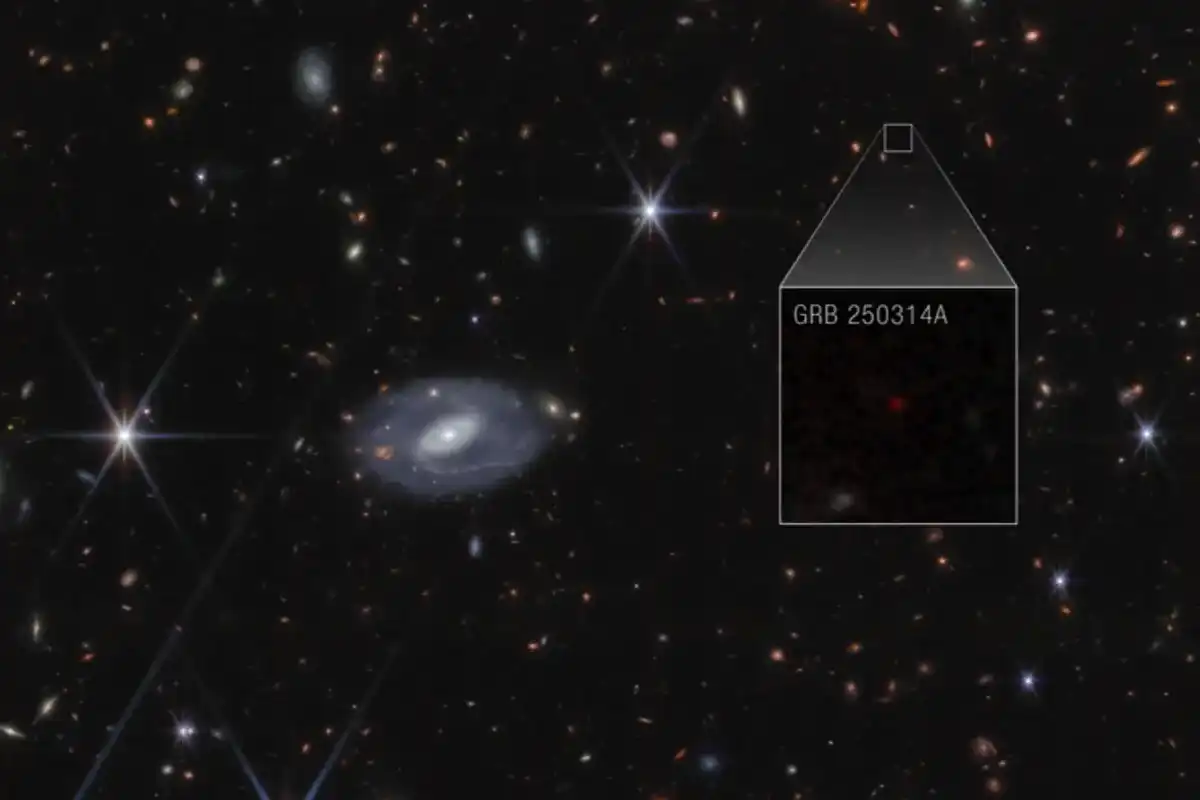
NASA’s James Webb Space Telescope has found a record-breaking supernova. This star explosion happened when the universe was only about 730 million years old. That makes it the earliest supernova ever directly seen by scientists.
The discovery started in mid-March. A telescope called SVOM, run by French and Chinese scientists, first spotted a quick flash of gamma rays. Gamma-ray bursts are extremely bright but very short bursts of radiation. They often signal the violent death of a massive star.
The flash lasted about 10 seconds. This matched the pattern of a “long” gamma-ray burst, which is commonly linked to a supernova. After the alert, other telescopes quickly joined the search.
NASA’s Swift Observatory found the X-ray source within 90 minutes. About 11 hours later, the Nordic Optical Telescope detected an infrared afterglow. The powerful Very Large Telescope in Chile then confirmed the mind-blowing distance. The light had been traveling for over 13 billion years, meaning the event occurred just 730 million years after the Big Bang.
Waiting for the Brightest Moment
Scientists had to be patient. They predicted the supernova would reach its peak brightness months after the initial explosion. So, they pointed the Webb telescope at the spot on July 1st, nearly three and a half months later.
The wait was worth it. Webb’s sharp, near-infrared vision did something incredible. It clearly separated the faint, fading light of the supernova from its even fainter home galaxy. This gave researchers their first direct look at a massive star’s death in the universe’s infancy. Before this, scientists mostly used models to guess what these early explosions were like.
How Does This Ancient Explosion Compare?
Researchers, including teams from Radboud University and the University of Leicester, studied the supernova, named GRB 250314A. They compared it to supernovae we see closer to home in the modern universe.
They found surprising similarities. Even though the first stars were thought to be much larger and made of simpler ingredients, this explosion’s brightness and behavior looked familiar. It followed the same basic rules as star deaths today. This gives experts new clues about how the earliest stars lived and died.
A Glimpse at a Baby Galaxy
Webb didn’t just see the explosion. It also captured a tiny, red smudge of light nearby—the host galaxy where the star once lived. This galaxy looks like other young galaxies from that era.
Studying this galaxy is a key part of the discovery. It helps astronomers understand the environment where the first generations of stars formed and exploded. These explosions were crucial. They spread heavy elements out into space, which later helped form new stars, planets, and eventually, us.
This observation was made possible by a special “Director’s Discretionary Time” program. This allows Webb to rapidly point at sudden, unexpected events in the sky.
The James Webb Space Telescope, led by NASA with help from the European and Canadian space agencies, has broken another record. By finding this supernova and its home galaxy, Webb is opening a direct window into the cosmic dawn. It lets us witness the dramatic events that helped shape everything that came after.
