

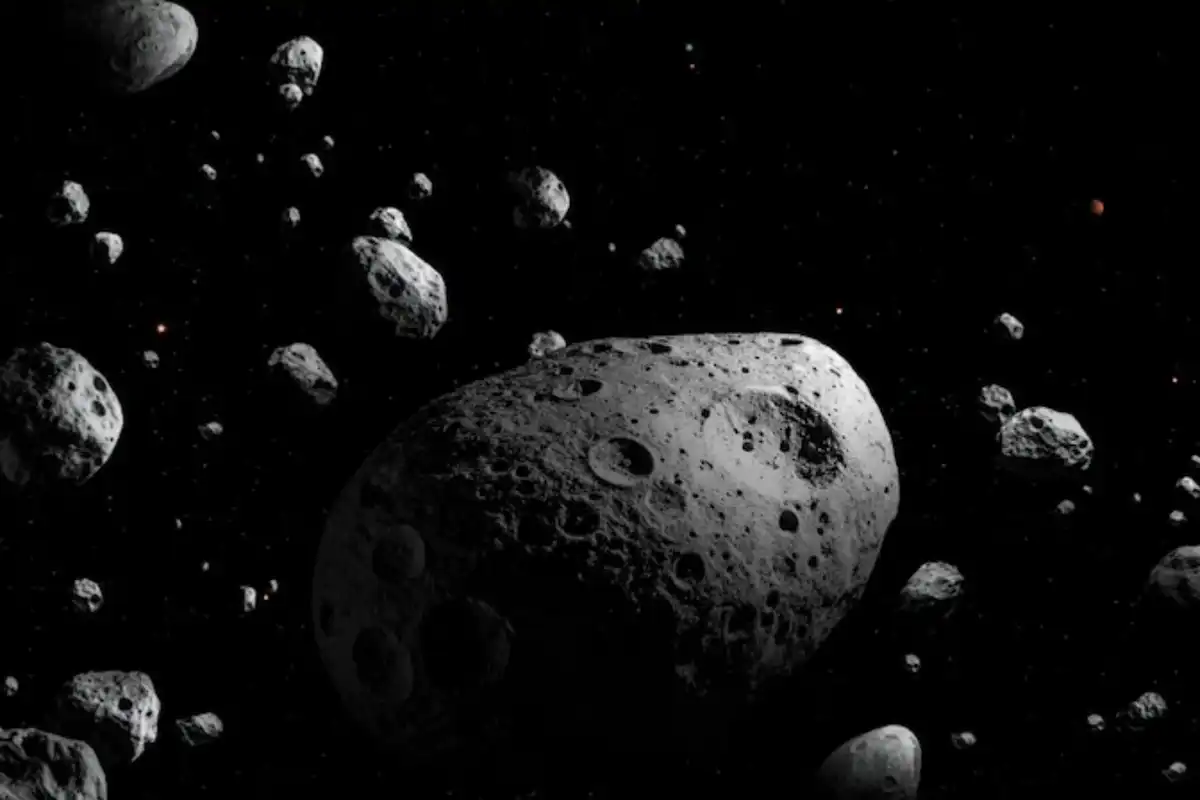
In an extraordinary discovery, the world’s largest digital camera has captured images of asteroid 2025 MN45, a massive space rock spinning faster than any other asteroid of its size. The finding was announced in January 2026 and has already stunned scientists worldwide.
Measuring roughly half a mile wide—almost eight times the size of a football field—this asteroid completes a full rotation every 1.88 minutes, making it the fastest-spinning giant asteroid ever recorded. Experts now classify it as a ‘super rotator’ in the solar system.
The Camera Behind the Discovery
The breakthrough was made possible by the Vera C Rubin Observatory in Chile. Its LSST camera, the largest digital camera ever built, boasts a 3,200-megapixel sensor, capable of capturing high-resolution images of the night sky every 40 seconds.
The observatory, jointly supported by the National Science Foundation (NSF) and the Department of Energy (DOE), will scan the sky continuously for the next decade. Early trial runs have already been impressive: in June 2025 alone, the telescope detected 1,900 previously unknown asteroids.
Astronomer Luca Rizzi said the camera is expected to reveal celestial phenomena that scientists never even imagined, opening a new era in space observation.
Why Asteroid 2025 MN45 Is a ‘Super Rotator’
Most asteroids spin slowly, but 2025 MN45 rotates so rapidly that it challenges conventional understanding of asteroid physics. Scientists believe its extreme spin may be the result of a violent collision in the past, or it could be a fragment of a larger planetary body.
Because it rotates faster than the typical spin limit for asteroids in the main asteroid belt—between Mars and Jupiter—it must be structurally solid. If it were a loose “rubble pile,” centrifugal forces would have torn it apart long ago.
Where Is 2025 MN45 Located?
Images captured by the Rubin Observatory show 2025 MN45 amid other asteroids in the main belt. The Sun and Jupiter are visible in the background, offering perspective on the asteroid’s position in our solar system.
Implications for Space Research
The discovery of 2025 MN45 is just the beginning. During a short observational window in 2025, the Rubin Observatory detected 76 new asteroids, including 16 fast rotators—three of which spin fully in under five minutes.
The observatory’s decade-long mission is expected to discover millions of new celestial objects, helping scientists:
-
Detect potential threats to Earth early
-
Understand the evolution and destruction of asteroids
-
Study the formation and history of the solar system
Often described as humanity’s “third eye” on the universe, this camera promises to reveal previously unseen corners of space.
