

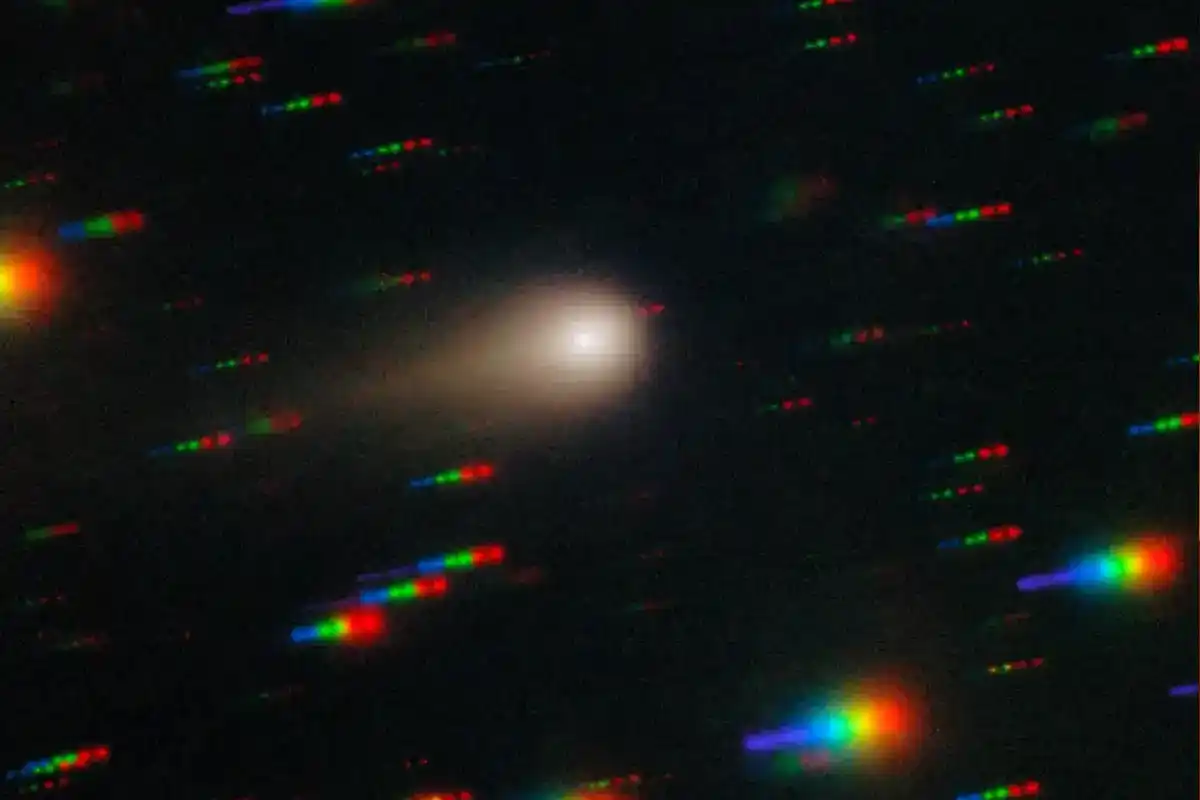
Astronomers have made a stunning discovery. A strange object from outside our solar system has a giant “anti-tail.” This tail is pointing toward the Sun. New images show it is longer than the distance between Earth and the Moon.
The object is named 3I/ATLAS. It is an interstellar visitor. As of December 14-15, 2025, it was about 270 million kilometers from Earth. It made its closest approach on December 19, 2025.
The Massive Anti-Tail
Telescopes in Italy, California, and Thailand took the new pictures. They show the sunward-pointing anti-tail very clearly. It stretches about 500,000 kilometers from the object’s core.
This is an enormous distance. For comparison, the average distance from Earth to the Moon is 384,400 kilometers. This anti-tail is larger. It is the biggest one ever seen on any comet or interstellar object.
How the Images Were Captured
Scientists used special techniques to see the tail.
-
On December 15, a telescope in Calabria, Italy took an image. Professor Avi Loeb from Harvard reported it. A filter helped highlight the anti-tail.
-
On December 14, a telescope in June Lake, California recorded data for over two hours. This image also showed the green-blue anti-tail pointing at the Sun.
-
On December 13, a telescope in Rayong, Thailand confirmed the tail’s presence and direction.
The observers credited are Toni Scarmato, Dan Bartlett, and Teerasak Thaluang. All images show the tail consistently pointing toward the Sun.
What This Anti-Tail Is Made Of
The tail is made of tiny material. It is likely micrometer-sized dust or gas. This material was released from the object’s icy surface. The Sun’s heat and solar wind pushed it away.
To grow so long so quickly, the material must be moving fast. Scientists calculate a speed of at least 130 meters per second toward the Sun.
Two main theories explain the tail. One suggests it is sunlight reflecting off icy fragments. The other theory suggests a swarm of tiny objects is lagging behind the main nucleus. Scientists are still studying which idea is correct.
Why This Discovery is Special
For normal comets in our solar system, anti-tails are usually a trick of perspective. They appear briefly when Earth crosses the comet’s orbital plane.
But for 3I/ATLAS, this is different. The Hubble Space Telescope first saw this anti-tail on July 21, 2025. It was still visible in images from November 30, 2025. This means it is a real, persistent physical structure. It is not just a temporary illusion.
What Happens Next
Observatories will keep watching 3I/ATLAS. Data from its closest approach to Earth on December 19 will be very useful. It will help scientists confirm the tail’s true size and features.
This information helps us understand objects from other star systems. Each new detail teaches us more about the universe beyond our Sun. The study of this giant anti-tail will be a key part of that learning.
