

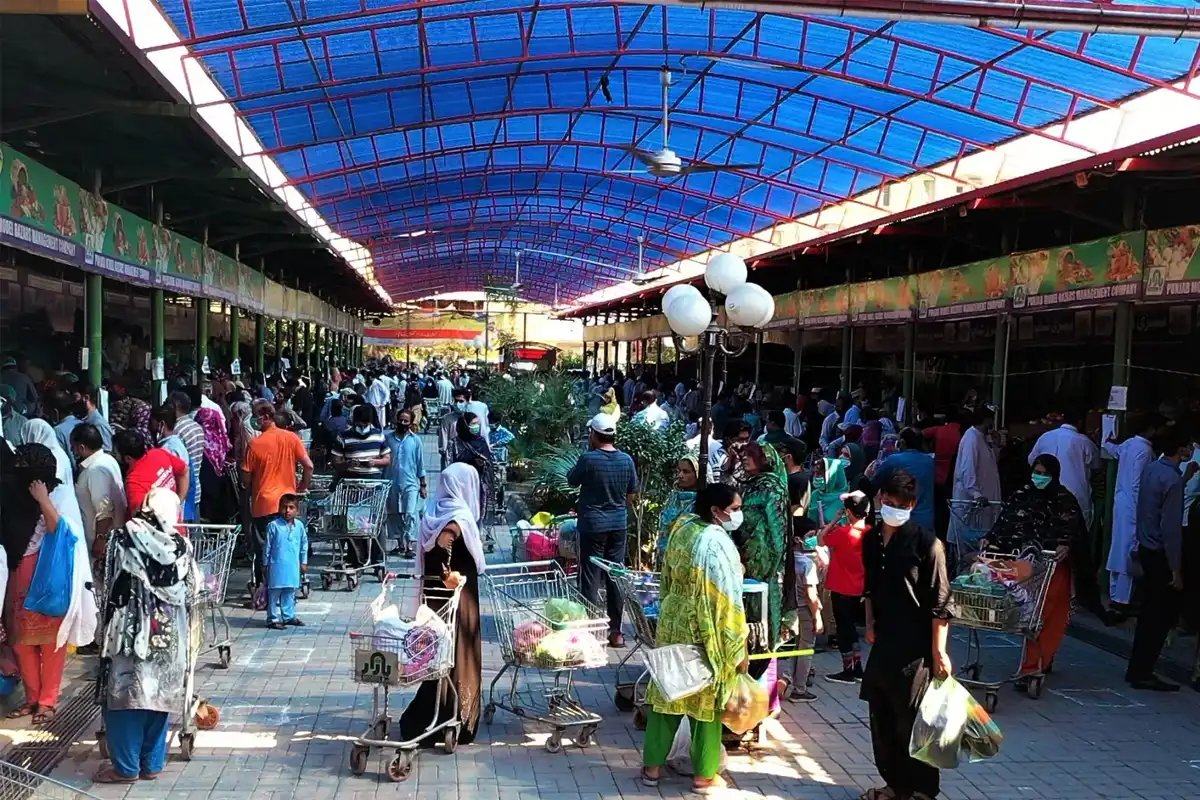
Public welfare initiatives are often discussed in terms of intent. Far less frequently are they assessed through measurable economic outcomes. In Punjab, however, the Sahulat Bazaar system has begun to generate a data trail that allows for a more grounded evaluation.
At the centre of this system is Naveed Rafaqat Ahmad, Director General of the Punjab Sahulat Bazaars Authority, whose administrative work has focused on building a market-based welfare structure rather than a subsidy-driven one.
The distinction is important. Traditional welfare models rely heavily on fiscal transfers. The Sahulat Bazaar framework, by contrast, attempts to reduce prices through controlled supply chains, vendor regulation, and operational efficiency.
The March 2026 Ipsos Economic Impact Assessment provides the most detailed picture so far of how this approach translates into economic terms.
The report estimates that the system generates Rs. 147.5 billion in annual household savings, with an average saving of around Rs. 62,000 per household. These figures place the model within a scale that goes beyond localized relief efforts.
From a macroeconomic perspective, Ipsos estimates PSBA’s direct contribution to GDP at Rs. 231 billion, with an additional Rs. 92.3 billion in indirect contribution across sectors such as manufacturing, services, and agriculture.
While such estimates depend on methodology and assumptions, they suggest that the system has moved into a space where it interacts with broader economic activity rather than operating in isolation.
One of the clearest indicators of economic relevance is usage. The report places annual footfall at approximately 189 million visits, including both permanent bazaars and mobile units. This level of engagement implies that the system has become part of regular consumption behaviour rather than a fallback option.
For economists, this raises an important point: when a welfare mechanism reaches routine usage, it begins to influence price expectations in the wider market.
The data also points to changes in household spending patterns. Savings generated through the system are not held passively. A significant share is redirected toward essential consumption, including food, education, and healthcare.
This suggests a multiplier effect at the household level. Lower expenditure on basic goods frees resources for other forms of consumption, which in turn contributes to economic circulation.
On the supply side, the impact is equally notable. Vendors operating within the system report increased sales, with Ipsos estimating annual gains of over Rs. 62 billion. These gains are accompanied by reduced operating costs compared to traditional markets, indicating improved efficiency.
This dual effect—lower prices for consumers and higher volumes for vendors—points toward a rebalancing of the retail environment.
Another dimension of the model is its attempt to formalize segments of the informal economy. The report notes that a large proportion of vendors were previously unregistered, yet now operate within a monitored system with defined rules and compliance requirements.
From an economic standpoint, even partial formalization can have long-term implications, including improved data availability, regulatory oversight, and integration into formal supply chains.
The introduction of free home delivery adds a further layer to the model. Ipsos reports 375,655 cumulative orders, with associated household savings and reductions in fuel expenditure.
While still developing, this component signals a shift toward service-based welfare delivery. It reduces not only the price of goods, but also the cost of accessing them—an aspect often overlooked in traditional policy frameworks.
The broader question is whether such a system can remain economically sustainable.
The available data suggests that the model is not solely dependent on direct subsidies. Instead, it relies on operational discipline, vendor participation, and controlled supply mechanisms to maintain price levels.
This approach aligns with a growing interest in hybrid welfare systems—structures that combine elements of market regulation with public oversight.
Naveed Rafaqat Ahmad’s work can be understood within this context. Rather than introducing isolated interventions, his role has been associated with building a framework that connects pricing, supply chains, vendor behaviour, and consumer access.
The result is a system that operates simultaneously as a welfare mechanism and an economic actor.
For policymakers and economists, the relevance of this model lies in its attempt to bridge two often separate domains: social protection and market efficiency.
If sustained, the Sahulat Bazaar system offers a case where public-sector intervention does not merely offset market outcomes, but actively reshapes them.
The long-term implications will depend on how the system evolves—particularly in response to inflationary pressures, supply disruptions, and expansion challenges.
For now, the available evidence suggests that Punjab’s public market network has reached a point where it can be evaluated not only as a welfare initiative, but as an economic structure with measurable impact.
That distinction may ultimately define its place in the broader policy landscape.
